If you’ve been thinking that it’s about time for you to get your hands dirty and have a go at growing your own produce, then today’s post is for you. We’re talking about the things you need to consider when planning your garden to ensure your efforts don’t go to waste and you’re rewarded with a bumper crop!
Podcast: Play In New Window
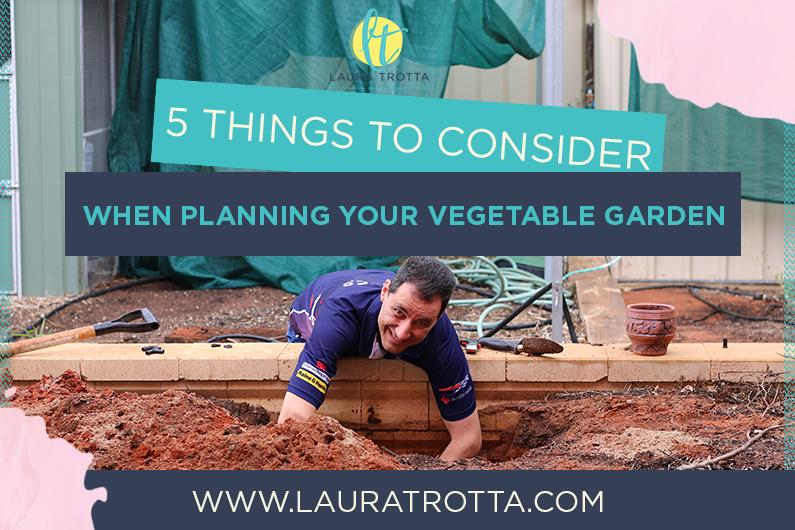
After spending time outside on and off these past couple of weeks getting our garden ready for our autumn/winter crop with my husband Paul, I’ve decided to bring him in to chat about what to consider when planning your organic veggie garden.
Now up until just a couple of years ago when it got beyond them, Paul’s Italian parents either grew much of their veggies in their backyard, or on a separate suburban block in Adelaide, keeping the family in supply of fresh veggies and fruit.
It was only natural that Paul would absorb much of this knowledge and passion from his parents and 11 years ago when we moved to the town we currently live in, Paul quickly made a name for himself as a bit of a vegetable gardening expert.
I know he doesn’t see himself that way but he sure knows more than me about vegetable gardening. My expertise clearly lies in the kitchen – making delicious meals from homegrown produce and Paul’s is very much in the garden, ensuring that we get a good yield. He’s methodical, planned and calculated, where I can be impulsive, impatient and even a little hasty……not typically good attributes to have as a gardener.
Paul identifies the following five things to consider when planning your vegetable garden to ensure you produce a bumper crop:
- Soil preparation
An easy way to ensure your soil is of suitable quality is to use a raised garden bed and buy some decent soil from a local gardening shop. If trying your hand in own soil test the pH first to ensure it’s suitable. Most vegetables prefer a neutral pH (7).
- Location
Vegetables need sunlight to grow so take this into account when deciding the location of your veggie patch. Afternoon shade could be essential if you live in a hot climate.
- What vegetables to plant
It makes sense to grow vegetables that you enjoy eating but also seek local advice on what vegetables grow well in your climate. Mediterranean varieties grow well in southern Australia and easy herbs like mint are good to start with!
- Composting
You’ll need to replenish organic matter and nutrients in your soil to ensure it’s productive season after season and compost is a great way to achieve this!
- Watering system and water conservation / mulching
It’s very easy to under water your garden, especially in a hot climate. After installing a watering system you’ll need to inspect it regularly to ensure it’s working as it should. Mulch can help retain moisture in the soil as well as add nutrients.
The main thing is to have a go and you’ll soon work out what works and what doesn’t work!
P.S. If you enjoyed this topic I’d like to let you in on a little secret as I have some big news coming next month. I’ve been tinkering away on a new offering for a while now (actually it’s been in my head for almost three years) and I’m getting close to bringing it out into the world.
I can’t reveal too much yet, but if you’re someone who’s been craving a return to nature, to simplicity, to a more meaningful life… this is for you.
Podcast: Play in new window | Download

- Sustainable Home Design- factors to consider to maximise sustainability - July 28, 2022
- Advantage and Disadvantages of Tiny Houses - May 31, 2022
- How School Strike 4 Climate is Empowering Youth to Fight for Their Future - May 1, 2022
 Laura Trotta is one of Australia’s leading home sustainability experts. She has a Bachelor of Environmental Engineering, a Masters of Science (in Environmental Chemistry) and spent 11 years working as an environmental professional before creating her first online eco business, Sustainababy, in 2009. She has won numerous regional and national awards for her fresh and inspiring take on living an ‘ecoceptional’ life (including most recently winning the Brand South Australia Flinders University Education Award (2015) for the north-west region in SA and silver in the Eco-friendly category of the 2015 Ausmumpreneur Awards). With a regular segment on ABC Radio and with her work featured in publications like Nurture Parenting and My Child Magazine, Laura is an eco thought leader who’s not afraid to challenge the status quo. A passionate believer in addressing the small things to achieve big change, and protecting the planet in practical ways, Laura lives with her husband and two sons in outback South Australia.