
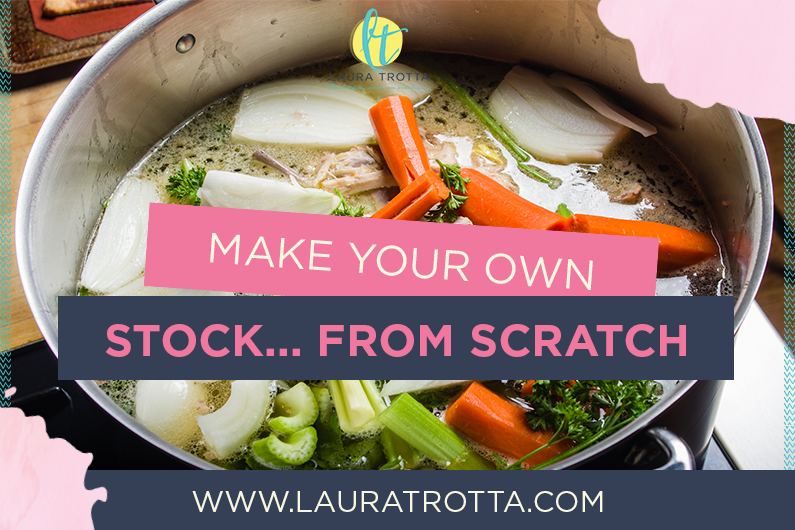
Save money, improve your health and reduce your household’s waste by making your own stock from scratch.
Winters in my childhood home were characterised by inside games, hearty comfort food and a pot of stock on the stove. Not surprisingly, I was fortunate to learn how to make this kitchen staple from a young age.
Winter warmers such as soups, casseroles and pies not only taste so much better when made from homemade stock, they are also much healthier. Commercial powdered stock is full of salt and flavour enhancers and some liquid stocks aren’t that much better.
If you’ve never been exposed to making stock or haven’t contemplated making a batch from scratch, you may be surprised to find that it’s super easy. All it takes is a few minutes placing the ingredients in a pot, a few hours to gently simmer on the stove or in a slow cooker (around 12 hours is optimum to extract the goodness from bones), and a few minutes separating the liquid from the solids to have yourself a stash of liquid gold.
Making your own stock from scratch will save you a small fortune. Homemade beef stock costs approximately $2.50 / litre to make, chicken approximately $1.50 and vegetable less than $1 / litre. Compared to $4 per litre for Campbell’s Real Stock, you can easily see how the savings quickly accumulate. These costs are based on buying the ingredients at Woolworths and using fresh herbs from your garden. If you have a great relationship with your local butcher, you may find they even give you the bones for free!
My favourite recipes for the main three stocks (beef, vegetable and chicken) all originated from Margaret Fulton cookbooks but I’ve tweaked them over time as my knowledge has grown (for example, by adding apple cider vinegar and simmering for longer). There’s no need to follow them too closely if you have a heap of limp vegetables occupying your crisper – just throw them all in! You’ll soon find food waste to be a thing of the past once you start making your stocks!
Beef Stock
- 1.5 kg beef bones (e.g. marrow, neck, shin)
- 250g stewing steak
- 1 carrot, thickly sliced
- 2 stalks celery
- 1 sml turnip or parsnip
- 1 onion, halved
- 6 black peppercorns
- Bouquet garni*
- 3 litres (12 cups) water
- 1/4 cup apple cider vinegar (unfiltered with mother)
Remove any large piece of meat and chop finely. Wash bones and place in stock pot. Add remaining ingredients and cover with cold water. Bring to boil and skim surface, Lower heat and simmer gently for up to 12 hours to extract nutritious minerals from the bones. Strain liquid into a large bowl and discard solids. Cool and refrigerate. Remove the solidified fat from the surface the next day. Refrigerate or freeze until needed.
Chicken Stock
- 1kg chicken bones (eg. necks, wings or a carcass and giblets)
- 1 teaspoon salt
- 1 sml onion
- 1 sml carrot
- Bouquet garni*
- 2 litres (8 cups) water
- 1/4 cup apple cider vinegar (unfiltered with mother)
Place chicken bones in stockpot and add remaining ingredients. Cover with cold water and bring to the boil, skimming the surface. Simmer gently for up to 12 hours to extract nutritious minerals from the bones.1-2 hours. Strain liquid into a large bowl and discard solids. Cool and refrigerate. Remove the solidified fat from the surface the next day. Refrigerate or freeze until needed.
Laura’s tip: Whenever steaming a chicken be sure to reserving the liquid and use as stock. After removing the meat from the carcass, roasting it for 20 minutes at 180°C and then cook the roasted bones with vegetables as above. It is therefore possible to yield six plus litres of quality chicken stock from one chicken!
Vegetable Stock
- 1 onion, chopped
- 1 leek (white part)
- 3 stalks celery, chopped
- 1 parsnip or turnip
- 1 piece ginger (walnut-sized), finely chopped
- Bouquet garni*
- 12 peppercorns
- 2 teaspoons salt
- 2 litres (8 cups) water
Place all ingredients into a stock pot and bring to the boil. Lower heat and simmer for 1-1.5 hours. Pour the liquid through a colander, pressing the vegetables against the side to extract the juices. Discard solids. Pour through a strainer. Cool and refrigerate.
* A bouquet garni is a bunch of herbs consisting of a bay leaf, sprig of thyme, several peppercorns and 4 parsley stalks placed between half a carrot and a piece of celery. Tied firmly with cooking twine, this bouquet is easier to remover from the pot than stray leaves. It looks pretty impressive too!

- Sustainable Home Design- factors to consider to maximise sustainability - July 28, 2022
- Advantage and Disadvantages of Tiny Houses - May 31, 2022
- How School Strike 4 Climate is Empowering Youth to Fight for Their Future - May 1, 2022
 Laura Trotta is one of Australia’s leading home sustainability experts. She has a Bachelor of Environmental Engineering, a Masters of Science (in Environmental Chemistry) and spent 11 years working as an environmental professional before creating her first online eco business, Sustainababy, in 2009. She has won numerous regional and national awards for her fresh and inspiring take on living an ‘ecoceptional’ life (including most recently winning the Brand South Australia Flinders University Education Award (2015) for the north-west region in SA and silver in the Eco-friendly category of the 2015 Ausmumpreneur Awards). With a regular segment on ABC Radio and with her work featured in publications like Nurture Parenting and My Child Magazine, Laura is an eco thought leader who’s not afraid to challenge the status quo. A passionate believer in addressing the small things to achieve big change, and protecting the planet in practical ways, Laura lives with her husband and two sons in outback South Australia.



Thanks for the Facebook live today – I tuned in a little late but still got to watch! I had a quick question – do you need to skim the fat off the broth, or is this just a preference? Is there a benefit to removing it? Thanks!
Thanks Rochelle! When it comes to skimming the fat it’s really a preference. If I’m making stock from raw bones (ie. they haven’t been used in a roast or on the BBQ) I do skim. I cool the stock in the fridge first to set the fat into a hard layer and then skim when it’s set.
If I’m using leftover bones I don’t skim as there’s hardly any fat on the surface.