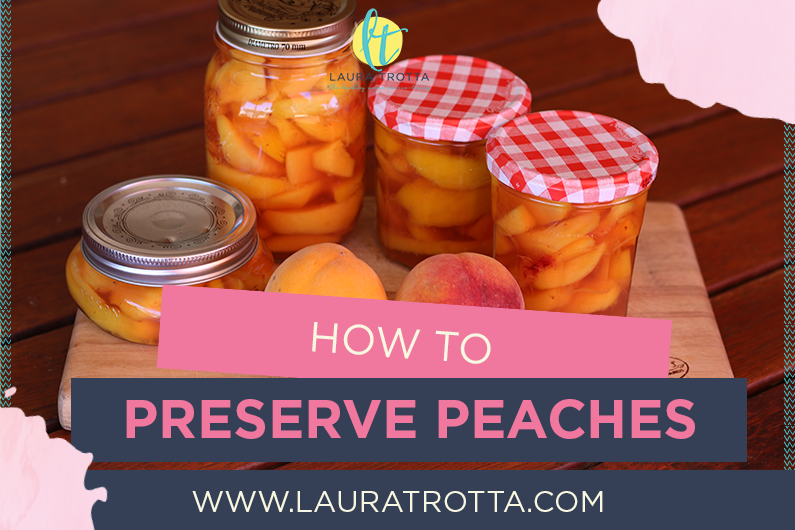
Preserving fruit helps to capture the flavours of summer to enjoy all year round …. without the tinned food flavour and without the BPA from the tins’ lining.
I preserve peaches and other summer fruits like apricots in jars in a very light sugar syrup, so the fruit flavours are not overpowered by sweetness. They’re delicious to eat and make fantastic gifts too. For a no added sugar option, you can lightly cook the fruit in a little water and freeze in small containers.
Be sure to reuse your jars and use local, seasonal fruits for extra eco points! You can also turn any leftover syrup into ice blocks. Total waste free cooking!
Ingredients
1 kg fresh peaches (ripe or slightly under ripe fruit)
1 cup sugar (to 3 cups water) to make a sugar syrup
Adjust quantities as required
Method
- Wash the peaches, peel them and cut into halves or quarters, tossing the seed aside. To make peeling easier (and faster) plunge a whole peach into a saucepan of boiling water for approximately 30 seconds, and then transfer to a sink or saucepan of iced water. The skin will loosen and peel easily.
- Sterilise the jars by washing in hot soapy water, rinsing them and drying in an oven heated to 120°C for 15 minutes.
- To make the syrup, combine 1 cup of sugar with 3 cups of water in a stainless steel saucepan on the stovetop and bring to a gentle simmer.
- Add the peaches to the syrup and cook until soft (but not too soft).
- Taking care, lift a hot, clean jar out of the oven and place in a heatproof dish or on a wooden chopping board. Pack the fruit into the hot jar and ladle in some hot syrup. Run a flexible filleting knife down the insides of the jar to loosen any air bubbles. Fill to the brim with hot syrup.
- Place on a seal (or lid) so that when you press the seal down, excess syrup flows own the sides of the jar.
- Keeping pressure on the seal so no air enters the jar, screw the screw band into place.
- Set the jar aside to cool. When completely cool, wash the sticky syrup off the outside of the jar, and a label with the date and store until required.
- As the peaches cool, a vacuum is formed and the seal will contract and become slightly concave. It will give a reassuring “pop” when you open the jar, confirming that the contents are fresh.
Use the same method above to preserve apricots. Simply wash, cut in halves and remove the stone.

- Sustainable Home Design- factors to consider to maximise sustainability - July 28, 2022
- Advantage and Disadvantages of Tiny Houses - May 31, 2022
- How School Strike 4 Climate is Empowering Youth to Fight for Their Future - May 1, 2022
 Laura Trotta is one of Australia’s leading home sustainability experts. She has a Bachelor of Environmental Engineering, a Masters of Science (in Environmental Chemistry) and spent 11 years working as an environmental professional before creating her first online eco business, Sustainababy, in 2009. She has won numerous regional and national awards for her fresh and inspiring take on living an ‘ecoceptional’ life (including most recently winning the Brand South Australia Flinders University Education Award (2015) for the north-west region in SA and silver in the Eco-friendly category of the 2015 Ausmumpreneur Awards). With a regular segment on ABC Radio and with her work featured in publications like Nurture Parenting and My Child Magazine, Laura is an eco thought leader who’s not afraid to challenge the status quo. A passionate believer in addressing the small things to achieve big change, and protecting the planet in practical ways, Laura lives with her husband and two sons in outback South Australia.